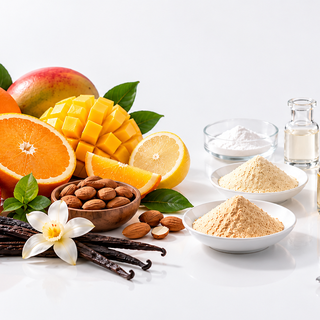
Synthetic flavoring ingredients are produced through chemical synthesis, while natural flavoring ingredients come from natural sources, such as plants or animals.
The main difference lies in their sources and production processes, not necessarily their safety. Both can be used in food products as long as they comply with applicable BPOM requirements and usage limits.
In the food and beverage industry, choosing the right flavoring ingredients affects more than a product’s aroma and taste. It can also influence production consistency, formulation costs, and the information provided on product labels.
Understanding the differences between synthetic and natural flavoring ingredients can help R&D, Product Development, QA/QC, and Purchasing teams select ingredients that best meet their product requirements.
What Are Flavoring Ingredients, and How Does BPOM Classify Them?
Flavoring ingredients are food additives used to provide or enhance the aroma and taste characteristics of food and beverages. They help establish a product’s distinctive flavor profile, such as strawberry, vanilla, citrus, or caramel.
Unlike sweeteners, salt, and acidity regulators, which contribute basic taste sensations such as sweetness, saltiness, and sourness, flavoring ingredients help create the distinctive flavor profile of a product.
Under BPOM Regulation No. 13 of 2020 on Food Additives for Flavorings, flavoring ingredients can be classified into three categories based on their sources and production processes:
- Natural flavorings: Obtained from natural materials through appropriate processes, such as extraction or physical and enzymatic methods.
- Nature-identical flavorings: Contain flavoring compounds with the same chemical structure as compounds found in nature but are produced through synthesis.
- Artificial flavorings: Use flavoring compounds that do not occur naturally in food.
For labeling purposes, nature-identical and artificial flavorings fall under the synthetic flavoring category. Therefore, the term synthetic flavoring does not necessarily mean that the compound has no natural counterpart.
To learn more about how flavor-related ingredients are used in food formulations, read our article on Flavor Enhancers: Functions, Types, and Examples in the Food Industry.
What Are the Differences Between Synthetic and Natural Flavoring Ingredients?
Synthetic and natural flavoring ingredients differ in several ways, including their sources, production processes, batch consistency, cost, stability, and labeling requirements.
These comparisons provide general guidance rather than absolute rules for every flavoring ingredient.
Natural flavoring ingredients are not always less intense or less stable, just as synthetic flavoring ingredients are not always more stable. Actual performance should be evaluated based on ingredient specifications and the product’s processing conditions.
Another important point is that synthetic does not automatically mean unsafe. Ingredient safety depends on safety assessments, ingredient identity and purity, and compliance with applicable usage requirements. The source of an ingredient alone is not enough to determine whether it is safe for use.
What Are Some Examples of Synthetic and Natural Flavoring Ingredients?
Synthetic and natural flavoring ingredients can be found in a wide range of food products.
However, it is important to distinguish between flavoring compounds, flavoring ingredients, and food ingredients that naturally contribute flavor. These do not necessarily fall into the same regulatory categories.
1. Synthetic Vanillin and Ethyl Vanillin
Both compounds are used to create vanilla-like aroma characteristics. Synthetic vanillin has the same chemical structure as vanillin found in nature, while ethyl vanillin is a different compound known for its strong vanilla-like aroma.
Their labeling classifications should be determined based on the identity of each ingredient and the applicable BPOM requirements.
2. Vanilla Extract, Citrus Essential Oils, and Oleoresins
These ingredients can provide aromatic compounds derived from plants. Their final characteristics depend on the raw materials and processing methods used.
Their classification as natural flavoring ingredients must still meet the regulatory requirements for eligible sources and production processes.
3. Fruit Powders
Strawberry, banana, and mango powders can be used as sources of fruit flavor and color in food formulations.
Unlike flavoring ingredients classified under food additive regulations for flavorings, fruit powders are food ingredients that contribute fruit characteristics to a product. Their classification and labeling depend on their specifications and production processes.
When Should You Use Synthetic or Natural Flavoring Ingredients?
Choosing flavoring ingredients should start with the desired flavor profile, product characteristics, manufacturing process, cost considerations, and intended packaging claims. No single type of flavoring ingredient is the best choice for every application.
Synthetic flavoring ingredients may be suitable when:
- Flavor consistency is a priority. Ingredients with controlled specifications can help maintain a consistent flavor profile across production batches.
- Formulation cost efficiency matters. Some synthetic flavoring ingredients are effective at low use levels, potentially helping optimize ingredient usage.
- The product undergoes specific processing conditions. For confectionery and bakery products, for example, flavor stability under heat should be evaluated to ensure the desired flavor characteristics remain after processing.
Natural flavoring ingredients may be suitable when:
- The product aims to highlight natural ingredient characteristics. Extracts or preparations from natural sources can help achieve the desired flavor profile.
- The target market values a clean-label approach. Ingredient selection can support the product concept, provided that packaging claims accurately reflect the formulation and comply with applicable requirements.
- Raw material characteristics are part of the product experience. Variations in aroma and taste from natural sources may be worth considering when developing premium products.
Manufacturers can also combine ingredients from natural sources with synthetic flavoring ingredients to achieve a specific flavor profile. However, these combinations should be evaluated for compatibility, stability, cost, and labeling requirements.
If a formulation contains synthetic flavoring ingredients, manufacturers should not claim that the product uses only natural flavorings unless the claim is supported by the formulation and complies with applicable regulations.
Before selecting ingredients, R&D teams should conduct formulation trials, while Purchasing and QA/QC teams should review specifications and supporting documents, such as the Certificate of Analysis (COA).
This approach ensures that decisions are based not only on price or initial aroma but also on ingredient performance in the finished product.
FAQ: Synthetic vs. Natural Flavoring Ingredients
Are synthetic flavoring ingredients harmful to health?
Not necessarily. The safety of a flavoring ingredient depends on its identity and purity, safety assessments, and compliance with applicable usage limits and requirements. Both synthetic and natural flavoring ingredients must be used according to the requirements for the relevant food category.
What is the difference between nature-identical and artificial flavoring ingredients?
Nature-identical flavoring ingredients contain compounds with the same chemical structure as flavoring compounds found in nature but are produced through synthesis. Artificial flavoring ingredients, on the other hand, use compounds that do not occur naturally. Under the applicable BPOM labeling requirements, both categories fall under synthetic flavorings.
Where can manufacturers buy flavoring ingredients and fruit powders?
Manufacturers can source these materials from food ingredient distributors that provide product specifications, technical documentation, and formulation support.
Bahtera Adi Jaya offers a range of ingredients for the food and beverage industry. Contact the Bahtera Adi Jaya team to discuss your product requirements and ingredient availability.
Choosing the Right Flavoring Ingredients for Food Formulations
Synthetic and natural flavoring ingredients each have distinct characteristics and considerations.
Synthetic flavoring ingredients may be suitable when flavor consistency and formulation efficiency are priorities, while ingredients from natural sources can support products that emphasize the characteristics of those ingredients.
The right choice depends on the product requirements, manufacturing process, cost, and applicable labeling regulations.
To select suitable ingredients, R&D, Purchasing, and QA/QC teams should evaluate product specifications, conduct formulation trials, and ensure compliance with applicable regulations.
With more than 20 years of experience, a portfolio of over 800 products and variants, and a network of more than 50 suppliers, Bahtera Adi Jaya supports raw material needs across multiple industries. Contact Bahtera Adi Jaya to discuss your flavoring ingredient and flavor enhancer requirements.